
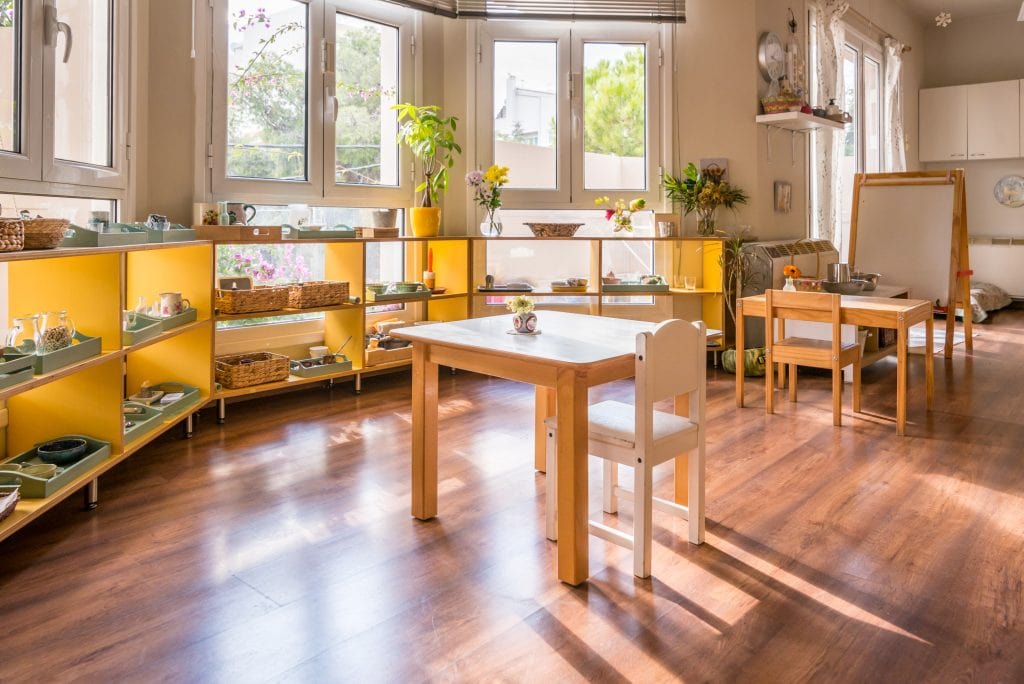
“The environment must be rich in stimuli that arouse interest in activities and invite the child to realize his own experiences.”
Maria Montessori
The Receptive Mind, p. 92.
When we think of a Montessori preschool classroom, the image of a well-prepared environment, tidy, beautiful, bright and clean springs to mind. A classroom that maximizes exploration and independent learning. A home made for the child, for the child, designed with thought and love, with real objects and multiple activities that offer a wealth of experiences. The child’s world is full of movement and joy, of interest and sharing, of safety and calm, of friends and trust.
The material is simple and beautiful, classified into sections, designed to cover the experience step by step, to increase its richness, to be used by the little hand, because that is what it was made for.
“The best for the least” is what Maria Montessori said and this is the thought of the classroom teachers.
To create an attractive, child-friendly environment, rich, with structure and order.
“The child, through the outer class, builds the inner class. It builds itself.” said Maria Montessori.
And really. Everything is in place, to give the child every possible opportunity to build a complete personality.
And the class does not stay within the narrow confines of the walls of the hall. With the same care it unfolds on the verandas, continues in the yard, takes shape in the library, is shared in the reception area and ends up in the kitchen, at the center of the family, at the table setting.
Careful and designed to respond to the all-round development of the child, favoring his freedom, promoting his concentration, allowing the harmony of relationships, removing obstacles, stimulating learning, the Montessori environment is itself The Teacher, created with an excess of love for the child.